If you've searched this question more than once, you've probably noticed every article gives you the same answer: "it depends," followed by a range so wide it's not actionable: anywhere from $10,000 to $250,000+. That range is technically true. It's also useless if you're trying to figure out whether your idea needs $15,000 or $150,000.
The more useful question isn't "what does an MVP cost." It's "which tier does my idea fall into, and what am I paying for at that tier." That's what this guide is for.
Which tier is your idea in?
Before looking at numbers, answer these five questions honestly:
- Does your product need to work on web only, or web and mobile (iOS/Android) from day one?
- Are you handling regulated data, such as health records, payment card data, or financial accounts?
- Does the core value proposition depend on AI (a chatbot, recommendations, document processing, generation)?
- Does your product need two-sided functionality, such as buyers and sellers, or multiple user roles with different permissions?
- Do you need real payment processing at launch, or can you validate demand first and add payments later?
If you answered "web only, no regulation, no AI, one user type, no live payments" to all five, you're in the simple tier. Two or three "yes" answers on complexity questions puts you in mid-complexity. Regulated data, AI at the core, or multi-sided marketplace mechanics puts you in the complex tier, and that's true almost regardless of how "minimal" you think your feature list is.
The three cost tiers, broken down
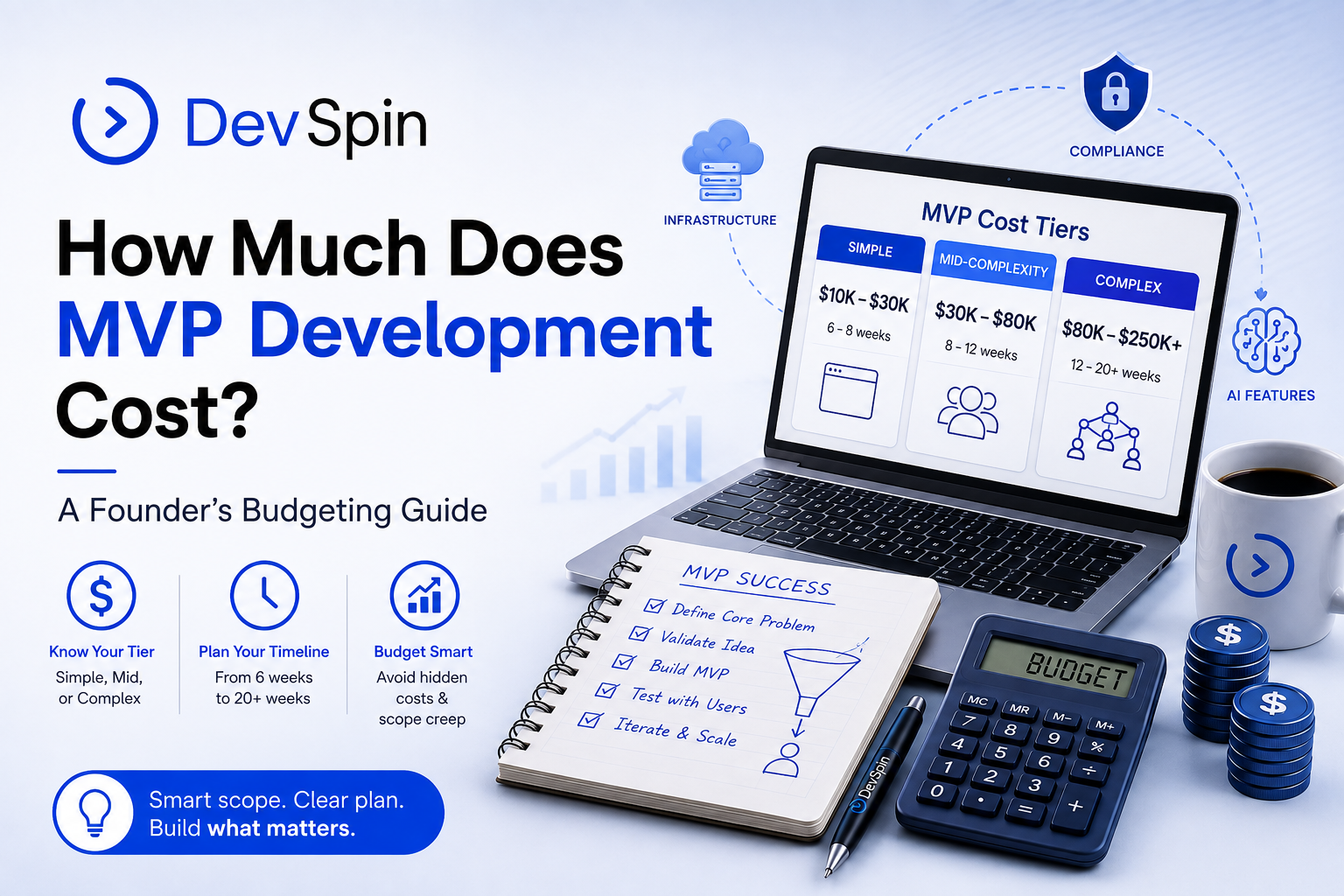
- Simple: $10,000 to $30,000, 6 to 8 weeks. One core feature, one platform (usually web), basic auth, simple admin view.
- Mid-complexity: $30,000 to $80,000, 8 to 12 weeks. Multiple features, user accounts, 1 to 2 third-party integrations, polished UI.
- Complex: $80,000 to $250,000+, 12 to 20+ weeks. AI features, multi-platform, compliance requirements, or multi-sided marketplace logic.
Two things founders consistently underestimate here. First, adding native mobile alongside web typically adds $20,000 to $50,000 to a web-only budget. It's rarely a small add-on, even with cross-platform frameworks. Second, AI features add more than a single line item. They tend to add 15 to 30% to the whole project, because data preparation, model evaluation, and guardrails work touch other parts of the build too.
What pushes an MVP over budget
Four things move a project from one tier to the next, almost every time:
AI as a core feature, not a bolt-on. A simple integration, such as calling an existing API, is cheap. A custom pipeline over your own data, such as retrieval-augmented generation, fine-tuning, or anything requiring evaluation and guardrails, is a different scope entirely, and it's the fastest-growing cost driver in 2026 builds.
Compliance. HIPAA, PCI-DSS, or GDPR-by-design requirements don't mean adding a checkbox. They mean encryption at rest and in transit, audit logging, role-based access control, and often a penetration test before launch. That work sits underneath the feature set, not on top of it.
Every additional platform. Web, iOS, and Android are each a meaningful cost multiplier, not a linear add. Cross-platform frameworks close most of the gap for standard apps, but they don't eliminate it.
Two-sided or multi-role systems. A marketplace with buyers, sellers, listings, messaging, and trust and review mechanics is a fundamentally different build than a single-user-type app, even with a similar-looking feature list on paper.
The costs founders forget to budget for
Most quotes cover build time. Fewer cover:
- Hosting and infrastructure from day one, not just at scale
- App store fees and review cycles, if you're going mobile
- Basic legal groundwork: Terms of Service and a Privacy Policy that match what your product does
- Post-launch maintenance: a reasonable rule of thumb is budgeting an additional 15 to 25% of your build cost for the first year of fixes, hosting, and small iterations after launch
None of these are optional once you have real users. Leaving them out of the initial budget is one of the most common reasons founders feel blindsided a month after launch.
Cost vs. timeline: the tradeoff nobody explains well
Faster isn't automatically more expensive, and slower isn't automatically cheaper. The relationship isn't linear either. Compressing a 12-week mid-complexity build into 6 weeks usually means adding a second developer or team in parallel, which raises cost without changing scope. Conversely, stretching a simple build over 16 weeks instead of 8 rarely saves money. It usually means the same cost spread over more calendar time, with more risk of scope creep along the way.
The useful question is: what's the cost of being three months late to market versus the cost of paying 15 to 20% more to compress the timeline?
For most founders validating demand, speed to real user feedback is worth more than the marginal cost difference.
How to keep your budget under control without cutting the wrong corners
- Cut scope, not quality. Fewer features built well beats more features built poorly. A smaller feature set doesn't have to mean a worse-feeling product.
- Decide what you're validating before you scope the build. If you're testing willingness to pay, you may not need real payment processing yet. A manual or semi-automated flow can validate demand at a fraction of the cost.
- Get a fixed-scope estimate before you get a dedicated team estimate. Fixed-scope pricing forces a specific feature list up front, which is a useful forcing function even if you end up choosing a different engagement model.
- Ask what "post-launch" looks like before you sign anything. A vendor who can't tell you their maintenance and support cost model upfront usually means that cost shows up later, not that it doesn't exist.
Need help scoping which tier your idea falls into? DevSpin builds MVPs in 8 to 12 weeks with transparent, fixed-scope pricing. A short discovery call is usually enough to tell you which tier you're in and what it will realistically cost. If you're earlier than that and still validating the idea itself, our product strategy and consulting service can help you chart the right technical path first.
Frequently asked questions
What's the cheapest an MVP can realistically cost? For a genuinely single-feature, web-only product with no compliance requirements, $10,000 to $15,000 is a realistic floor with an experienced team. Below that, you're usually looking at a no-code prototype rather than a production-ready MVP.
Is it cheaper to hire freelancers than an agency? Freelancers typically have a lower sticker price, but the tradeoff is usually project management, quality consistency, and continuity risk if someone drops off mid-project. For a single simple feature, freelancers can work well. For anything with multiple moving parts, the coordination overhead often erodes the savings.
Does adding AI always make an MVP more expensive? Not always. Calling an existing AI API for a well-defined task is relatively cheap. It's custom AI pipelines over your own data, or anything requiring evaluation and guardrails, that meaningfully raises cost and timeline.
Should I build for web or mobile first? If your users are primarily on desktop for the core task, such as a B2B dashboard, start web-only. If the core interaction is inherently mobile, such as on-the-go field work or consumer social, mobile-first is usually worth the added cost.
How much should I budget beyond the initial build? Plan for an additional 15 to 25% of your build cost in the first year for hosting, maintenance, and small iterations. Treat this as part of your MVP budget, not a surprise later expense.
How long does a typical MVP take to build? Simple builds: 6 to 8 weeks. Mid-complexity: 8 to 12 weeks. Complex (AI-native, compliance-heavy, or multi-platform): 12 to 20+ weeks.
Have a project this makes you think about?
Talk to Us →